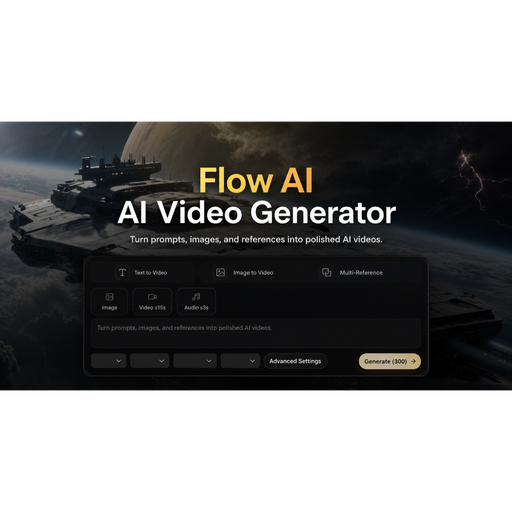
Kling 4.0: High-Performance Text-to-Video AI Engine#
Executive Summary & Quick Verdict#
Kling 4.0 is a freemium text-to-video AI generator engineered to streamline media synthesis workflows. Designed for software engineers, indie hackers, and product builders, it delivers high-performance video generation via an accessible web interface. It successfully minimizes the friction associated with complex video rendering pipelines, earning a solid 4.5/5 rating for rapid prototyping.
The Core Problem: Why Modern Workflows Break#
Engineering teams and product builders frequently encounter bottlenecks when trying to integrate dynamic media assets into applications or prototyping pipelines. Traditional video production tools require manual rendering, expensive software suites, and specialized hardware. This creates a high barrier to entry for teams needing programmatic or rapid iteration of visual assets. Modern software workflows require instantaneous, programmatic, or on-demand generation capabilities that fit seamlessly into cloud-native environments.
Architecture & Tech Stack Spotlight#
Built on top of a Modern Web Stack, Kling 4.0 abstracts away the underlying neural network execution layers. Instead of forcing developers to manage PyTorch runtimes, CUDA drivers, or cluster orchestration, the service exposes functionality via a clean web-first interface.
- Client Layer: Responsive single-page application handling parameter tuning and asset previewing.
- Execution Layer: Cloud-hosted inference clusters optimized for high-throughput tensor calculations.
- Delivery Pipeline: Low-latency asset streaming and storage for generated MP4 outputs.
This architecture ensures that developers can initiate complex generation tasks without worrying about client-side hardware constraints.
Deep-Dive: Key Capabilities & Workflows#
1. Prompt-to-Video Synthesis#
The core engine translates natural language prompts directly into coherent video frames. By leveraging advanced diffusion models, it handles spatial consistency and motion dynamics efficiently.
2. Freemium Prototyping Pipeline#
The platform's tier structure allows developers to test concept viability before committing capital. The freemium model supports quick validation of generated output quality for specific use cases.
3. Web-First Accessibility#
Eliminating local installation requirements, the platform provides immediate access through standard browsers, enabling distributed teams to collaborate on visual assets synchronously.
Who Is It Built For?#
- Software Engineers: Building applications that require automated or programmatic media generation endpoints.
- Indie Hackers & Startup Founders: Needing marketing assets, landing page videos, or product mockups without dedicated video production staff.
- Product Builders: Testing AI-driven UI/UX concepts and multimedia user journeys.
Transparent Tradeoffs & Considerations#
While Kling 4.0 reduces the overhead of video creation, engineering teams must evaluate its reliance on managed cloud infrastructure. Because the core inference runs externally, high-volume production use cases require careful analysis of rate limits, pricing tiers, and data privacy policies.
Pricing & Value Assessment#
Operating on a freemium model, Kling 4.0 allows users to test core functionality at zero initial cost. Paid tiers scale resource allocations for heavier workloads, offering a predictable alternative to managing dedicated GPU infrastructure in-house.
Final Verdict & The LaunchNests Recommendation#
Kling 4.0 is a practical utility for technical founders and engineering teams looking to bypass manual video creation bottlenecks. Its modern web architecture and freemium accessibility make it an efficient addition to the modern product builder's toolkit.